|
 |
|
|
|
|
||
|
|||||
|
|||||
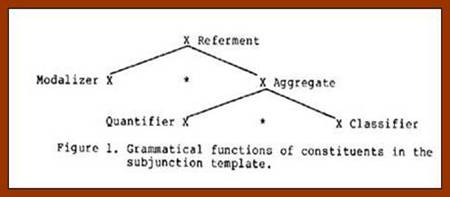
DOING MORE WITH STRUCTUREEldon G. Lytle Function and CategoryLinguists have long recognized a distinction between function and category, i.e. something categorized as a noun can function as a subject, as an object, etc. The category of a constituent is normally given as a node label. Function, on the other hand, is either implicitly given by the structural context of the constituent or, if context is missing or insufficient, by label also. One of the motivating assumptions of junction theory was that the actual set of structural relationships used in the construction of sentences (the set of grammatical functions) was really much richer than what linguists and grammarians had supposed, and, consequently, much richer than the set of functions expressed by any available notational system. Given that this was true, then it followed that at least some functional information was being intermingled with categorial information in the form of node labels or features; or alternatively, that many functional contrasts not successfully expressed by structure were being given as derivational (transformational) relations. Junctions were introduced for the express purpose of enriching the set of functional relations, and, as an immediate consequence of the superior generative power of the junction rules, together with the introduction of lexical rules to code between data types, the need for structural transformations was eliminated. Moreover, some functionally colored node labels, such as complement, were discarded, since whether or not a given constituent was a complement was as obvious from the enhanced context of the junction tree as whether it functioned as a subject or object. The notation for constructing J-trees utilizes three basic junction operations (adjunction, conjunction, and subjunction), twelve node categories (N, V, Ad, P, PN, PV, PA, PP, SN, SV, SA, SP), and a semanticon (a dictionary of sememes). While this system is sufficiently powerful to explicate a broad variety of structures, it is inadequate in crucial ways. Specifically, since the semanticon is simply a list of sememes rather than an information net showing sememic interaction, features must be added to represent other relevant properties of sememes (e.g., <Definite/Indefinite>, <Human/Non-human>). Some of these features are of particular theoretical interest because they have a functional flavor: Notice that the same noun, for example, which is indefinite when first used in a conversation, is definite thereafter (e.g. I saw a little boy and a dog. The little boy…) Thus, little boy is neither inherently definite or indefinite, but rather, is definite or indefinite depending upon the context in which it occurs. The need to augment The RefermentRecent work with junction trees shows that an effective way to enrich structure is to expand each node of the basic SX (statement) into a referment (see Figure 1). The internal structure of the referment is devised to provide specific slots for information that seems essential to every act of reference, regardless of category. It is intended that the referment be to subjunction what the statement (SX) is to adjunction, namely, a structural template that defines certain grammatical functions. Thus, while the adjunction template defines the grammatical functions of predicator (nucleus), object, subject, predicate, and predication, the subjunction template in question defines the grammatical functions of quantifier, classifier,modalizer, aggregate, and referment. These functions remain the same regardless of the basic category of the template, as is also the case, of course, with the functions of the adjunction template.
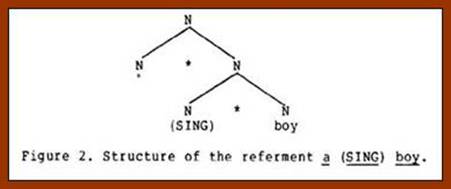
The quantifier, as suggested by its name, defines the scope of the focal referent of the referment. The classifier tells where to find it in the net. The aggregate represents the focal referent at its location in the net. The modalizer specifies discourse status and the referment asserts the occurrence of the modalizer and aggregate as a token in discourse. For example, the structure of a boy appears in Figure 2.
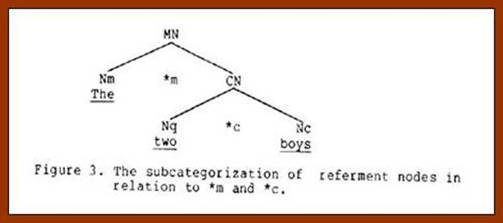
The classifier is boy; the quantifier, which is lexically covert (understood), establishes the scope of the core as singular (SING); the aggregate (SING)-boy asserts that the nucleus is a boy; the modalizer the fixes a discourse mode; and the entire referment asserts the occurrence of a-(SING)-boy as a token in discourse. Since the various constituents in the referment have distinct semantic properties, subjunctions to the template at different points have different semantic consequences. For example, subjunctions to the quantifier modify the scope of the referent (more boys/many more boys); subjunctions to the classifier modify the scope of the class (the little boys); subjunctions to the aggregate resolve the identity of the quantifier within its class (The little boys that we saw) and so on. This outcome is precisely what was anticipated, of course, given our prior experience with the contrasting semantics of modifiers at locations in the adjunction template. We return to this topic directly. Notational ConventionsWhile the global category of basic constituents in a given referment will be the same (N, V, SV, etc.) the use of composite labels for the various constituents in the referment facilitates reference to them out of their larger structural context. In defining these labels we recognize a systematic relationship between junction operations, the category of junction operands, and the category of constituents formed by junction operations. The operation that subjoins the quantifier to the classifier is a classifying operation and we therefore annotate it as ‘*c’. The operation that subjoins the modalizer to the aggregate is a modalizing operation; hence we annotate it as ‘*m’. We label the non terminal nodes as shown in Figure 3, where CX is the aggregate (X is the simple category) formed via ‘*c’ and MX is the referment finalized by way of ‘*m’. Terminal nodes are indexed so as to designate the junction in which they participate, the quantifier given as Xq, the classifier as Xc, and the modalizer as Xm. These notational conventions, as indicated, enable one to designate the syntacto-semantic specialization of constituents and operations apart from their structural context.
It is not necessary, of course, to affix subcategory labels to the nodes in this manner when the operational context of structure is present.
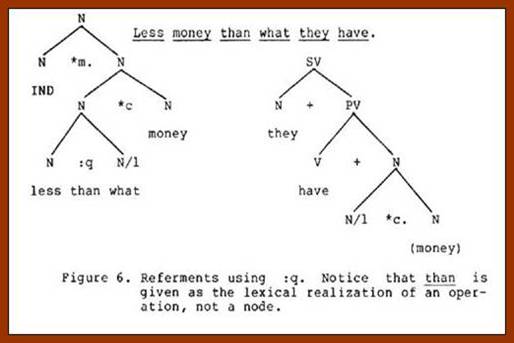
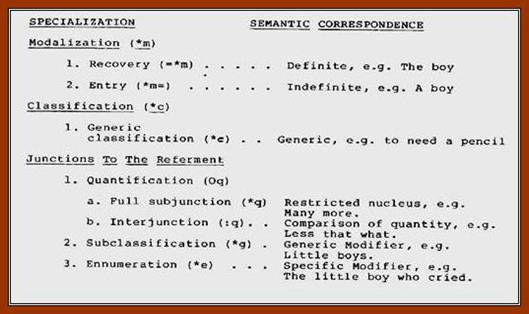
Specializing ‘*m’It was noted above that the feature <Definite/Indefinite> seems to befunctional rather than referential. Since our motivation for introducing the referment was to eliminate the need to use such features, it is important to see whether there is some natural way to reflect this functional contrast in the referment. One alternative, the first that comes to mind actually, is to use Nm to distinguish between definite and indefinite noun referments. Since Nm is now a node, we could simply enter sememes in the semanticon corresponding to the various noun modal words (e.g. articles), and specify them as definite or indefinite. This solution, however, contradicts the observation that the contrast in question belongs to the structure of the tree. But if this is actually the case, where in the tree does it belong? Another alternative, of course, is to account for the definite/indefinite contrast in terms of ‘*m’, the modalizing subjunction. We, like many other linguists, make note of the fact that definite reference seems to entail the use of information already documented by the hearer, while indefinite reference seems to entail the introduction of new information. In the first case (definite reference) it is plausible to suppose that the purpose of the referment is to recover a semantic index from the information system and assign it as the referential value of Nm. Let us designate this specialization of ‘*m’ as ‘=*m’, suggesting recovery from the net and assignment to the modalizer. The feeling of definacy associated with ‘=*m’ is thus attributable to the process of recovering an index previously documented by the system. In the case of indefinite reference, the purpose of the referment seems to be that of entering a new index into the system. Let us designate this specialization of ‘*m’ and ‘*m=’, suggesting entry into the net. The feeling of indefinacy associated with ‘*m=’ is attributable to the process of entering an index not previously present in the system. While the use of ‘*m’ to account for the definite/indefinite contrast seems more correct than simply entering definite and indefinite indices for Nm into the semanticon, we now notice with considerable interest that Nm in the context of ‘=*m’ has to have different properties than it does in the context of ‘*m=’. In the first instance, Nm is a nominal variable to be assigned the value of the index recovered from the net, while in the second instance, Nm represents the value of the new index to be entered. Thus, the ultimate solution is to combine the second alternative with the first, i.e. to give the definite/indefinite contrast both in terms of the modalizing operation and the operands that it selects. This is not surprising since it confirms once more the systematic interplay of referential and structural meaning. Junctions to the RefermentIt was noted above in passing that since the various constituents in the referment have unique semantic properties, junctions to the template at different points have different semantic consequences. We now define quantification (Oq), subclassification (*g), and enumeration (*e] as specialized junctions which may occur on the quantifier, the classifier, and the aggregate, respectively. QuantificationThe quantifier refers to quantity, degree, or amount, depending upon the reference of the classifier. If it is not countable, then the quantifier will refer to a mass. If its referent is countable, then it may specify the quantity in terms of the gross oppositional values SING/PLUR (normally covert at the lexical level), identify a precise cardinal quantity (one, two, three, etc.), or give as the quantity a relative value to be calculated with reference to other precise quantities (more, less, as. .as). Quantification (Oq) is used for the calculation of these relative values and has two specializations – an explicit specifier (*q), and a comparison (:q). The first is exemplified by expressions such as three more, many less, etc. and typically entails full subjunction (see Figure 5). The latter is exemplified by comparatives such as more than five, less money than what they have, etc. Comparisons often use interjunction as a means of identifying quantities (see Figure 6).
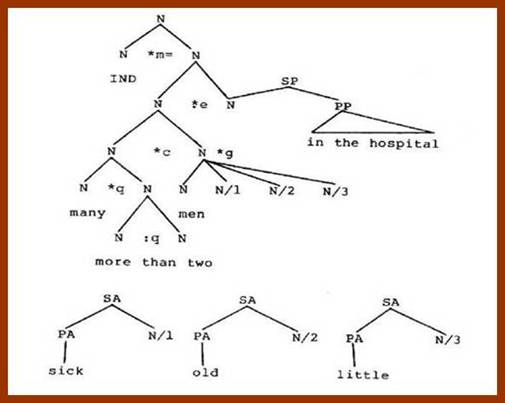
SubclassificationThe reference of classifiers is often narrowed via restrictive modification. As noted above, we assume that there exists for this purpose a special subjoining operation and refer to it as subclassification ‘*g’. For example, little old sick men joins three SA's to the classifier men, each defining a new sub-genre of men (assuming the junctions occur recursively), or defining one sub-genre (assuming the junctions occur iteratively). (See Figure 7.) It is emphasized that subclassification does not alter the generic nature of the classifier. It only restricts its scope, resulting in sub-genres, also defined by abstraction rather than by enumeration. The classifier is presumed not to be enumerable in and of itself. EnumerationThe aggregate is enumerable. Its enumerability derives from the quantificational reference of the quantifier, plus the generic reference of the classifier, its two component parts. In other words, quantification is presupposed by enumeration. Enumeration (*e) is the operation which actually provides the specific reference of referments based on common nouns. For example, the little old sick menin the hospital not only has the three generic modifiers of the previous example joined to the classifier via ‘*g’, but also an SP joined to the aggregate via ‘*e’ (see Figure 7).
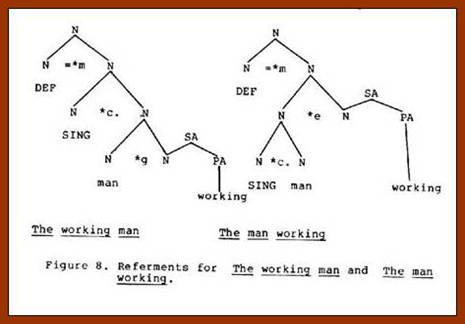
Figure 7. Referment for ‘many more than two little old sick men in the hospital.’ We conclude by pointing out that the structural semantics of the referment remove the need for features relating to both specificity and number. Thus the contrast between the working man and the man working is a reflection of differing referment structures (see Figure 8).
A summary of specialized junctions discussed in connection with the referment is given in Table 1.
|
|
|
|
[Home] [Origins] [Article Archive] [Foundations] [Formalizations] [Analyses] [Pedadogy] [Forum] [Guest Book] [BYU] |
|
|
|
Copyright© 2004 Linguistic Technologies, Inc. |