|
 |
|
|
|
|
||
|
|||||
|
|||||
|
|
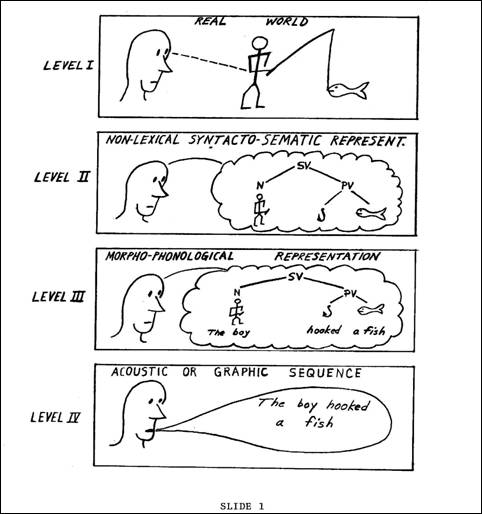
ESSENTIALS OF JUNCTION GRAMMARBy Rey L. Baird BrighamYoungUniversity March 1972 Junction Grammar presupposes four distinct levels of linguistic representation. These levels - as reflected in Slide 1 and beginning with level I - are supposed to reflect a step-by-step generation of language. Level I is more than just linguistic, as you note. It is the real world around us, from which we draw information through our senses to be communicated through language.
Level II exists in our minds. This is a mental level, wherein we construct concepts of the world around us - the real world - not in terms of words, but rather in terms of mental pictures, units of meaning, which we call sememes. These sememes are related to each other in a variety of ways through certain syntactic rules to form the so-called syntacto-semantic representations shown in the slide. Level III also exists in our minds, and is the result of a process of assigning lexical items, or words, to the mental constructs produced in level II. At this point, too, a particular order of utterance is assigned, and everything is made ready for a grand entry into the world of speech. Level IV is just that - the spoken word; the utterance itself, in terms of actual acoustic signals or in terms of auditory perception, or as visually perceived on the written page. To achieve all this, three sets of rules have been postulated (Slide 2), each set of rules operating at a given point in this sequence to produce the structure at a given level needed as input for the next step in the process of speech production.
As shown in this diagram (Slide 2), J-rules inter-relate these sememes I referred to in order to produce the syntacto-semantic configurations of level II. From level II to level III, L-rules operate on these configurations to assign words in their proper order, and all of the superficial paraphernalia that is involved in grammar and morphology as we now know it. Then phonological rules assign the proper acoustical value to the word sequences produced at level III to give us level IV. It should be noted that L-rules do not modify the basic syntactic relationships assigned by the J-rules.
Junction Grammar, as we are concerned with it here, comprises the first two sets of rules we have talked about. It should be noted that the set of phonological rules - the last set of rules to apply - constitutes a universal theory of phonology which is applicable to this grammar, or other theoretical approaches to language analysis. Our task now is to understand how the J-rules function to accomplish the role they have been assigned. We will have a bit more to say about the L-rules later. As we noted, J-rules join sememes into larger expressions, which, in turn, may be joined together to form yet more complex configurations until the actual complexity of natural language is achieved. The three types of J-rules needed to accomplish this are called adjunction, conjunction, and subjunction rules (Slide 3).
Adjunction rules build the basic configurations which reflect the particular grammatical relationship which traditionally has been referred to as predication. For example, the subject-predicate relation is the most commonly recognized predicational, or adjunction, relationship. We likewise see in the verb-object relationship (the top tree structure) this same predicational phenomenon. This adjunction relationship has also been attributed to the relation between an adjective and the noun it modifies (as indicated at the bottom), an adverb and the verbal element it modifies, or to a prepositional phrase and the element it modifies. This claims, then, that the predication relationship is operative on the phrase level as well as the clausal level. It is appropriate to note here the basic configuration of all the diagrams of this slide. This is the adjunction configuration, and it should be noted that as we develop more complex tree structures, this configuration serves as a basic, modular-type structure which is used over and over again within the development of a sentence.
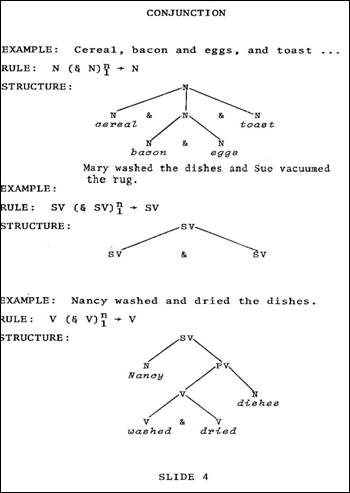
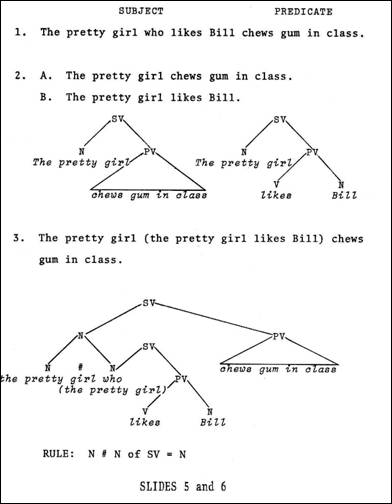
Conjunction (Slide 4), a second process reflected by J-rules, is the one we will discuss next. With this operation, either sememes alone or more complex configurations may be joined to a given node in a tree diagram to produce a sequence of like elements. This operation is traditionally referred to as the process of co-ordinating conjunction, and may operate on any node of a tree, as long as only categorially similar nodes are conjoined. In the second example of Slide 4, two full sentences are conjoined. Up above, note that it is a series of nouns - nominal expressions - which are being conjoined. It is not appropriate to conjoin unlike elements, such as a noun and a verb, for example. We do not say *The boy and running went home. The girl or some other noun can be conjoined to the boy but not a verb or some other construction. This type of rule - this conjunction rule – introduces into the grammar the property of recursion, which gives to language its ability to produce an infinite number of sentences of indefinite length and complexity. Subjunction rules - the next type of rule we will consider - also provide recursive power to the grammar, and correspond to the grammatical phenomenon known as subordination. Basically, subordination is the process of modifying a given element of language in such a way as to restrict, amplify, or clarify its referential scope. Let's consider some examples in a more traditional framework. We say that a relative clause modifies its antecedent, and modify, or modification, is the term we shall dwell on now. In the sentence of Slide 5, The pretty girl who likes Bill chews gum in class, who likes Bill is called a relative clause; and the so-called antecedent of this relative clause - the thing it modifies -- is girl.
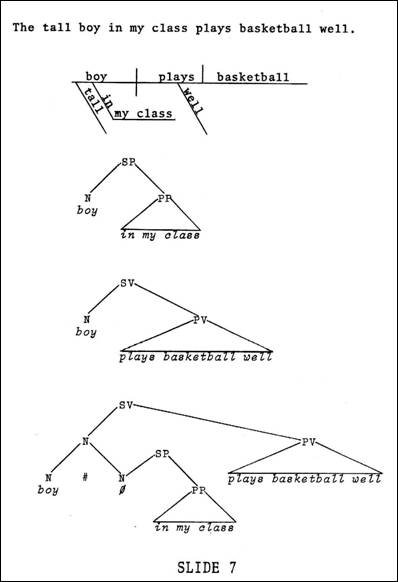
In this case we actually have two clauses within the sentence: The pretty girl chews gum in class and The pretty girl likes Bill. If we diagram these two clauses individually, we get the diagrams illustrated in Slide 5. And we also recognize that the whoof the original sentence in the second clause represents the individual person referred to as the pretty girl. Notice that the function of the relative clause is to restrict the discussion of pretty girls to only that one who likes Bill. And this is one instance of the process of modification, or if you will - subjunction. Now in a relative clause construction, it is easy to see that one clause overlaps or, as we say, intersects another clause at a particular point. In this sentence that we are considering, the noun subject of the second clause intersects with the noun subject of the first clause. Consequently, all of clause number two becomes part of the subject of clause number one. Our diagram indicates this (Slide 6 above). The subject of clause number one has the dominant N, which stands for the subject whose predication - if you will - is chews gum in class. If we reflect this overlapping - or intersection - in a diagram (such as the one we have) we simply combine the two clauses as shown. While combining the two clauses we have maintained our two basic structures and at the same time indicated the point of overlap, which is indicated by the triad of N's; we have indicated the operation of subjunction, which produces this overlap, by the double-cross juncture, which was the signal for subjunction. (The asterisk is now used in place of the double-cross juncture.) We have also indicated the fact that the pretty girl who likes Bill is the subject of the dominant sentence by introducing it into the tree on the N node which dominates the triad. It is appropriate at this time to point out the rule which accomplishes this subjunction. The rule is written at the bottom of Slide 6 and is read as follows: "to an N, subjoin the N of an SV, which yields a dominant node of the same kind, an N." And this is what we have accomplished in the diagram. A perusal of any relative clause construction will reveal this same relationship. We can consider a variety of relative clauses: We saw the boy who was here yesterday - here we have a subject subjoined to a direct object, for ex ample; The boy whom we saw was here yesterday switches it to where we have a direct object subjoined to a subject; and so on. In each case, one clause is modifying another. The clausal modification is not the only type of modification we find in language. Possibly even more common is the phrasal-type modification. We often refer to adverbial phrases or adjectival phrases or prepositional phrases which modify a specified element in a sentence. Consider the sentence of Slide 7: The tall boy in my class plays basketball well.
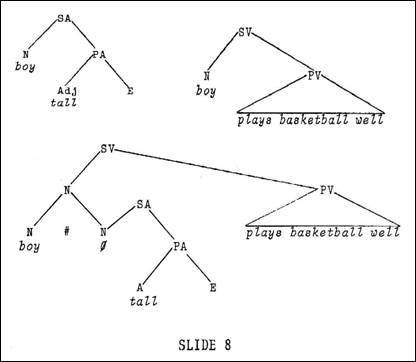
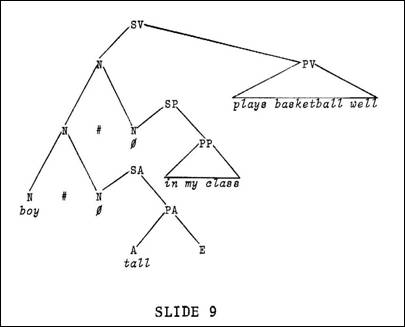
It is common practice in such a sentence to refer to the prepositional phrase, in my class, as modifying the subject, boy. In fact, traditionally we diagrammed it with just that idea in mind. Now if we are serious about modification being accomplished through the process of subjunction, we need to apply that process here. We noted earlier that prepositional phrases could function in a predicate relationship to various sentence elements, and in this case perhaps we will find it can function predicatively to a noun. Our adjunction construction would look like the example in Slide 7. This is an adjunction construction, showing the prepositional phrase predicating the noun. (This is what we talked about earlier.) Boy, however, also serves as the subject of the predication plays basketballwell, as is also shown in the slide. Obviously we have two adjunction structures that overlap, that share an element in common. That is what we had in our relative clause sentence, so, following the modificational procedure, we subjoin the phrase boy in my class to the clause boy plays basketball well at the point of overlap. This yields the tree diagram shown at the bottom of Slide 7. The only difference between this subjunction and the relative clause subjunction is that, in English, relative clause subjunction is signaled by an overt lexical marker, such as who or which or that - the things we call relative pronouns. Prepositional phrase subjunction, however, does not have any such overt signal, in English. Nevertheless, we do have modification with an intersection between clause and phrase, and that is the issue. Incidentally, it might be appropriate to point out that in Samoan there is characteristically no relative pronoun marker; but, quite frequently, other types of subjunction markers are manifested. This failure to lexicalize a given node is indicated on the tree diagram by the null symbol (Ø), as shown. Returning to the sentence we just considered, we note that the prepositional phrase, in my class, is not the only modifier of boy. The adjective tall is also a modifier. Again we recall that adjectives stand in a predicate relationship to nouns, as is shown in Slide 8.
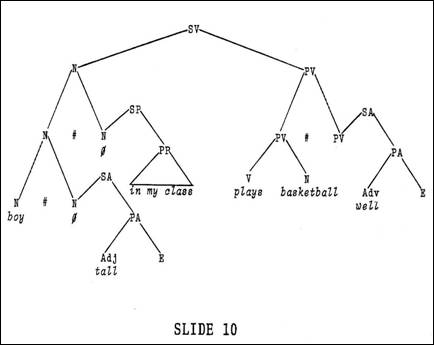
We have the same adjunction configuration that we have with prepositional phrases, only this time it is an adjective rather than a preposition which functions predicationally with boy. Again applying the principle of subjunction, we combine this adjunction configuration with the SV construction, and the result is as shown. Since the prepositional phrase discussed previously modifies tall boy rather than just boy, we include it in the tree diagram above the subjunction of the adjective to indicate the proper relationship of the two subjoined elements (Slide 9).In other words, since in my class is subjoined to the N node dominating tall boy, the tree diagram is to be read such that tall boy is modified by in my class; i.e. the entire lower configuration is modified by the prepositional phrase. By now it should be obvious that the manner adverb well, that modifies plays basketball, can be handled in essentially the same way (Slide 10).
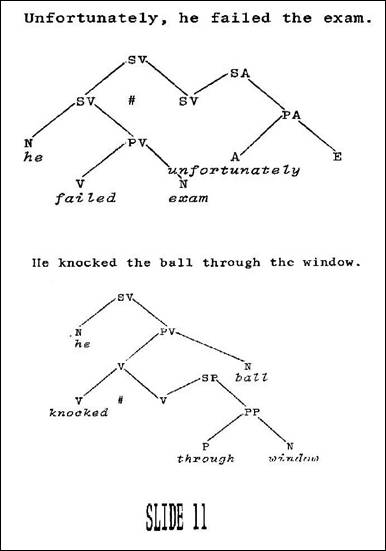
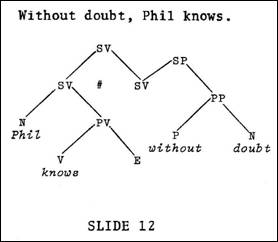
It should he noted that adverbs may function predicationally on all levels of structure, on the sentence level in such sentences as Unfortunately, he failed the exam, where the adverb unfortunately modifies the entire sentence, he failed the exam (Slide 11) - or on the predicate level, as in the sentence we just considered, The tall boy plays basketball well, where well modifies the so called predicate, plays basketball. And we can go on and show that adverbs may modify verbal elements on a verbal level, as in the sentence He knocked the ball through the window (Slide 11). The prepositional phrase here, an adverbial element, is modifying knocked rather than the entire PV structure, which would include knocked and ball. These different positions of modification allow for a discreet and principled way of identifying such types of adverbial elements as manner adverbials, adverbs of location or destination - i.e. the various kinds that we recognize as existing in language. Slide 11 also illustrates the fact that, like the so-called pure adverbs, prepositional phrases which function adverbially may modify sentence elements other that nouns, as we saw originally. Here a prepositional phrase is subjoined to the verb knocked. In the sentence Without doubt, Phil knows, we have an example of a prepositional phrase, without doubt, modifying an entire sentence, Phil knows (Slide 12).
We find, then, that the point of modification - where adverbial or adjectival structures or prepositional structures are concerned can vary according to what is actually being modified.
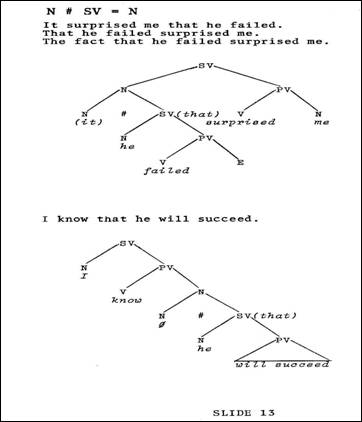
At this point in our discussion we should call attention to the fact that, in each example of subjunction we have considered, there has been the characteristic triad comprised of two subjoined elements and the dominating node, which categorizes the subjunction. In each case the elements subjoined have been of like category, both nouns, or both verbs, or both PV's, as in the last case. And this type of subjunction - that achieved between elements of similar category we designate as homogeneous subjunction. Let's now consider a type of subjunction referred to as heterogeneous subjunction, wherein the subjoined nodes are of different categories. Let's consider, for example, the sentence It surprised me that he failed (Slide 13). Careful consideration of the two clauses involved leads one to the conclusion that the second clause, he failed, serves to amplify the subject of the first clause, which is, of course, it. In fact, the noun subject it receives its referential value from the entire clause, he failed. This identify of reference is precisely the same thing we noted as overlap in the relative clause construction considered earlier. Mere the overlap is between a noun and an entire sentence rather than between two nouns. Our diagram clearly shows the heterogeneous nature of the two nodes joined in the subjunction operation.
Let me point out that, although in the sentence of Slide 14 we have an example of an SV subjoined to an N, the entire SV is the object of the preposition about, and we end up with the sentence He knows nothing about John concealing evidence. The -ing node, which is subjoined to the SV, signals the nominalization of the verb in the SV construction, and we get what is commonly referred to as a derivational structure. One of the very powerful uses of Junction Grammar is this direct and explicit way of generating derivational structures. Let's look at some other examples here to see the scope of this derivational generation.
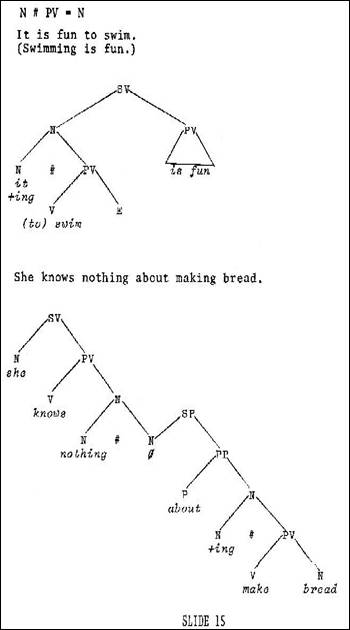
Notice that in the sentence of Slide 15, the rule above indicates we have a PV subjoined to an N dominated by an N, and functioning as the subject of the SV. We can say It is fun to swim, and the value of it, of course, is swim 'Swim' is fun; and we properly say swimming when we make such a verb a noun. If we do not use the -ing structure, we can say alternately To swim is fun, and to in this case signals the nominal function of the verb. Or we can give the sentence as it is shown, It is fun to swim. She knows nothing about making bread (Slide 15 above). This sentence, again, has this subjoining on an N. But it is not an SV that is being subjoined; it is a PV. Make bread is a predicate construction. And we want to nominalize that predicate construction by subjoining it to an N, whose signal is -ing, which - in terms of lexical order - is attached to the verb; and all of this functions as the noun object of the preposition.
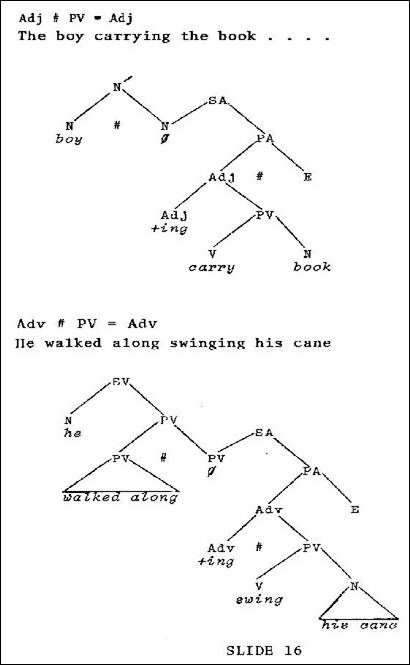
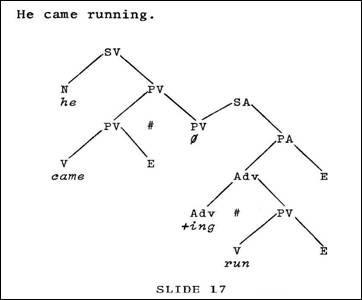
The boy carrying the book ... (Slide 16). Notice this active participle, where we subjoin an entire SA construction to a noun; in other words, we are modifying this noun by an adjectival construction. The adjective is signaled by the We can do the same thing with adverbs that we do with adjectives. He walked along, swinging his cane (Slide 16). Swinging his cane obviously modifies how he is walking. It functions in this modificational way, and is subjoined as an adjective to the PV - I'm sorry, an adverb. Let me note at this point that according to the theory, the only distinction between adverbs and adjectives is in terms of what they modify; and if you consider your traditional approach to grammar, we call those things that modify nouns adjectives (and that is how we define adjectives - they are things that modify nouns), and we call every other kind of modifying element an adverbial element (it does not modify nouns -- it modifies other things). And so if I confuse them or if I have not noted specifically whether it is an adverb or an adjective, it is because within the theory this is not significant. One final slide which indicates essentially this same thing (Slide 17). Here is a verb being adjectivalized with an -ing ending. He came - in what fashion? - he came running. And we have this typical subjunction configuration, which builds this construction in a straightforward way.
Let me talk for a few moments about one or two aspects of the theory, and I will be finished. It should be noted that all of the rules of this grammar are computable; in other words, because of the fixed nature of these rules, the kinds of rules with the constraints imposed on them can be fed into a computer, and every possible variation of the rule can be computed. This is in contrast to theories that are being developed today in linguistics where the set of rules needed to produce language is an open-ended set - we see no end to the number of rules we will need. In Junction Grammar, there is a fixed number of rules available. This is not to suggest that all languages utilize all of these rules, however. The set of rules is considered a universal set from which all languages of the world draw to generate their sentences, one particular language using this given subset of the universal set, another language using a different subset of this computable set of rules, and so on. It is interesting to note another ramification of this particular thing. I need to build a little background for it before I can come back to this idea of languages utilizing a universal set of rules. In many sentences we note a concept or phenomenon referred to as syntactic inversion. Take a sentence like the one that Dr. Lytle has used previously: The car that the truck had hit rolled over. You can invert this sentence, such that it is expressed The truck had hit the car that rolled over. Or, I carried an umbrella because it was raining. -- It was raining so I carried an umbrella. The one sentence is the inverse of the other. Now it turns out that in English we have both possibilities as I have illustrated with these pairs I have cited for you. But this is not necessarily the case in all languages. It is my understanding, for example, that Japanese has available only those rules which will give one of these pairs. And so in the translation process that Dr. Lytle is involved in here - if one of these sentences goes into the computer and Japanese does not have that particular construction, the inverse of it is available, and can be generated by the computer. And we lose little or nothing in the process of translation. A final comment about the lexical rules: these are the rules that take us from level II to level III. There are four types of rules here, and their names are somewhat self-explanatory. Let me just indicate briefly how they function. We need to remember that, at level II, these diagrams we have seen are kind of free-wheeling mobiles - no order to them. And it is not like boy hits girl is at level II; all we have at level II are the unitsboy, girl, and hit, related to each other in certain syntactic configurations but not ordered as they come out of our mouth. Obviously we have to speak in some linear sequence (we haven't found any other way yet) and so we need the lexical ordering rules to impose a fixed word order on these elements according to the constraints of individual languages. And since each language has a different set of ordering rules, we have to write, for each language, a set of Lexical-ordering rules which take us from level II to level III. Lexical hiatus rules - the second type - are rules which specify non-lexicalization of elements which are understood. For example, in an imperative like Go home!, we often say that the you subject is understood. These L-H (for lexical hiatus) rules are the rules which allow for this recognition of understood elements on this lower level of language production and allow for these elements not being lexically realized in the string that is produced. The lexical matching rules actually match up with the mental concepts of level II the given word from a particular language which will express that mental concept. In our first diagram (Slide 1), the mental concepts of the boy, catching, and fish need the words attached to them which correspond to these concepts, which is what the matching rules do. Finally there are lexical agreement rules which tack on all the different types of agreement affixes that we note in inflected languages of the world, such as Spanish, German or Russian. In English these rules put the third-person singular ending on verbs according to the third-person quality of the noun, for example. These rules will also attach number or gender markers in such languages as Spanish or German - these outward trappings that we need before we can get to the final utterance.
|
|
[Home] [Origins] [Article Archive] [Foundations] [Formalizations] [Analyses] [Pedadogy] [Forum] [Guest Book] [BYU] |
|
|
|
Copyright© 2004 Linguistic Technologies, Inc. |