|
|
|
|
|
||
|
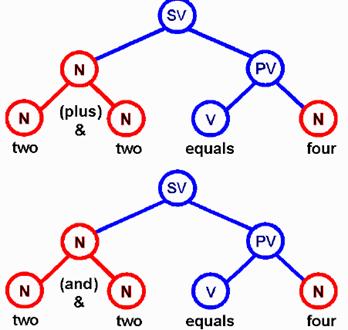
JUNCTION GRAMMARA MODEL OF LANGUAGE FOR THE CLASSROOMBy Ronald P. Millett OrientationJunction Grammar was pioneered by Eldon Lytle during the 1960's as he studied for his Ph.D. degree in Linguistics from the University of Illinois at Urbana-Champaign. Dr. Lytle believed that the linguistic theories that were dominant at the time were inadequate in their ability to describe natural language in a complete and simple manner. Beginning in the 1950's, revolutionary linguistic theories began to be developed that borrowed many concepts from the field of formal languages extant in mathematics and computer science. These theories for the first time showed how language could be generated from sets of rules, which was a major step forward. For many years, any model of language that made different assumptions than the dominant Transformation Generative Grammar (TGG or TG) theory was considered “out of the mainstream of linguistic thought” and its proponents found it very difficult to even publish their research results. Even today, with many variations of linguistic ideas now flourishing, all of the best known theories still rely heavily on a foundation of formal language theory. Two Plus Two and the Need for OperatorsThe clearest indication that current linguistic theories are overly complex is that they are rarely taught in other college language departments, much less in the primary and secondary schools. In Language Included™ we cite the copy connection (conjunction) as a good example of the need for junctions or operators in describing natural language. The dominant linguistic theories use concatenation-only phrase structured grammars (PSG) at their foundation, forgetting as it were to bring along the arithmetic operators such as the plus and minus signs as they borrowed from mathematics. In what follows we will show diagrams comparing JG with various popular linguistics theories and methods of diagramming sentences. We do this only to show at a high level the difference in complexity and simplicity between these methods and the Junction Grammar approach. For example, here is a Junction Grammar diagram of the simple sentence, two plus two equals four or two and two equals four.
Textbooks of the latest “Government and Binding” version of the Transformational Grammar theory rarely even mention how to diagram a sentence with a conjunction like and.[1] There is considerable debate in graduate school classes about how conjunction could be represented and still maintain the binary branching of the latest GB theory. What ought to be a simple “2 + 2" kind of diagram has become a difficult problem, probably because what should be an operator (the + sign) has been transformed into a specialized node in a phrase structure grammar. Here is how TG would diagram the above sentence Two and two equals four.
Here is a diagram of a conjunction example using Lexical Functional Grammar (LFG), a theory that in many ways, like Junction Grammar, was a reaction to Transformational Grammar. The German phrase being diagramed is Wirtschafts- und Währungs union (“economic and monetary union”).[2]
LFG adds extra data structures called F-Structures (the lower tables in the diagram) to add additional semantic and lexical information to the phrase structure diagrams, called C-Structures in LFG. Note that the conjunction operation groups the two adjectives in the F-Structure under the conjunction operator. What is easy to understand from this diagram is that this simple sentence can cause a very difficult mathematical representation for some theories. The traditional 1877 Reed-Kellogg (RK) diagrams had a straight-forward representation of conjunction. Here is a Reed-Kellogg diagram of the sentence They washed and dried the sticky pots and greasy pans.[3] Notice that the JG diagrams identify more about the sentence and still, the RK diagrams, maintain simple and intuitive sentence pictures.
One verses Multiple TreesA second characteristic of modern linguistic theories was to force all of the clauses and modifiers in a sentence to be in one big tree structure. This is just like a mathematical problem would be solved level by level on a blackboard. The old RK diagrams allowed the distinction between a complement and a relative structure. For example, here are RK diagrams for two sentences that show this distinction. The dashed line links the relative pronoun and its antecedent of the two clauses togeher. The pedastal-like drawing links the embedded clause into the main clause.
Here are the JG diagrams for these same sentences. The distinction between the relative clause and the embedded clause are easy to see.
In TG diagrams of complement and relative clause sentences a”trace” link is needed to show the intersection of reference for the relative clause.
The intersection of trees on the element they have in common is such a powerful intuitive method of showing the meaning of the sentence. Taking away multiple trees makes the diagram more cumbersome as it eliminates a clear contrast between relative and complement structures and then adds another subscripted trace feature to link up nodes.
Strict Ordering of Rule OutputsA third important attribute of the dominant linguistic theories is to force the processing or traversal of language structures in a strict left to right or right to left ordering. This was not a requirement of the earlier RK diagrams but is the way mathematical formulations are processed like derivations would appear on a classroom blackboard, again borrowing from mathematics. Forcing a left to right ordering through a single tree structure to lexicalize a sentence is like having to actually move the roads around in a city to make sure that a visitor does not hop around in his traversal of the town’s streets. If he planned to visit “Main” street first, then “Highland” street four blocks north of Main street and finally “Ohio” street four blocks south of Main street, we would have to quickly move Main street temporarily five blocks north of its current location while he visited it. Then he would visit Highland street south of the moved Main street and then Ohio street south of Highland street. This shuffling of streets might remind one of the Harry Potter movies where the staircases in the dormitory at Hogwarts School moved around in a most curious way as they tried to find their way to their rooms. Diagrams are made more complex and less intuitive by this massive moving operation that takes place in the lexicalization (making into a string of words) of the sentence. Here is a TG diagram where many transformations take place from deep structure to the final surface structure of the sentence. Notice the many rerouted “streets” that move around to fit into the strict ordering through the tree. The sentence being pictured is Which job has Sally declined?[4]
Right out of the Natural WorldThe basic joining operations that are used in JG have parallels in the natural world. Indeed, perhaps as the Creator used language structures to organize our planet to be suitable for habitation by His children even the physical world continues to reflect principles of linguistics.[5] As we look at a bunch of cherries on a small twig, it is not difficult to see the major operations of conjunction, subjunction and adjunction. The cherries relate to each other first as a conjunction of several cherries into a common set. Secondly, the cherries are connected to different positions on the nourishing branch, two at this point and four at another point. This relationship seems to involve subjunction as “these two cherries” or “those four cherries” are pointed out. Finally, the descriptive differences between the cherries would involve adjunction. One cherry is described as the “reddest cherry” of the group, another is the “least ripe cherry,” another “the smallest cherry,” and so forth. Levels of Language RepresentationsLanguage can be compared to a four step manufacturing process. Raw materials enter the factory at one end. The raw materials are processed into refined materials which are then made into component parts. Component parts are assembled together to make the final packaged products, which are then ready for shipment out the other end of the factory.[6] The real world is the first level that is defined in the four levels of language representations used by Junction Grammar. An apple can represent itself. This level could represent the raw materials entering the factory.
The second level is the Mind Language that exists in our brains. This level draws on language independent concepts coupled with the specific structures and meanings used by our native language. The linkage from the real world (Level 1) to our minds (Level 2) is through the senses. The senses might be compared to the refining machinery that produces the refined materials in the first section of the factory. Once we have formulated an idea we wish to communicate using the structures of the mind, the mental representation is then processed from the Mind Language into the third level of language representation, a language specific string of words that is still only in the mind. This linkage from Level 2 to Level 3 occurs completely within our brains. This is the step where language specific words are accessed, and various language specific rules are applied to the Mind-Language sentence. This step might be compared to the piece part manufacturing process in the factory. Actual spoken or written words only occur at the fourth level in the Junction Grammar model. The level 3 unspoken words are used to control the voice for spoken output or control the hand in writing or typing the final language output. The linkage between level 3 and level 4 comes from the phonological and phrasal intonation rules of the specific language or the rules for writing out a sentence. This step might be compared to the assembly of piece parts into the final products in the factory. Here are two illustrations of the levels of representation and processing that go into the JG model. Sememe is another word for a Mind Language concept.
Language Included!The ability to use language is truly an amazing endowment. Our study of language and its almost endless versatility as an instrument of thought and communication has only made us more appreciative of this divine gift. We earnestly hope that students of Language Included™ will gain added insight into how language can better work for them as they endeavor to read, write and communicate better.
[2] Miriam Butt, Stefanie Dipper, Anette Frank, Tracy Holloway King, 1999. Writing Large-Scale Parallel Grammars for English, French, and German. Proceedings of the LFG99 Conference. Available on the web at www-csli.stanford.edu/publications/. [3] Gene Moutoux, 2000. Sentence Diagrams: One Way of Learning English Grammar. Web address: http://www.geocities.com/gene_moutoux/basicdiagrams26-30.htm. Moutoux’s book A Workbook of Sentence Diagramming, now in its second edition, is advertized at the web site. [4] Black, op. cit., p. 27. [5] Eldon G. Lytle, 2003. LANGUAGE in CAPITAL LETTERS. E-book issue, first edition. Linguistic Technologies, Inc. Las Vegas, Nevada. Preface and section 8.1.2. [6] Charles D. Bush, 1973. Fundamentals of Junction Grammar. p. 13-34. |
|
[Home] [Origins] [Article Archive] [Foundations] [Formalizations] [Analyses] [Pedadogy] [Forum] [Guest Book] [BYU] |
|
|
|
Copyright© 2004 Linguistic Technologies, Inc. |